

Top 5 mRNA Vaccine Myths
Dig deep into the most typical myths about the COVID-19 Vacines that you are likely to find on the internet.
DE-BUNKING
D-M
5/10/20263 min read
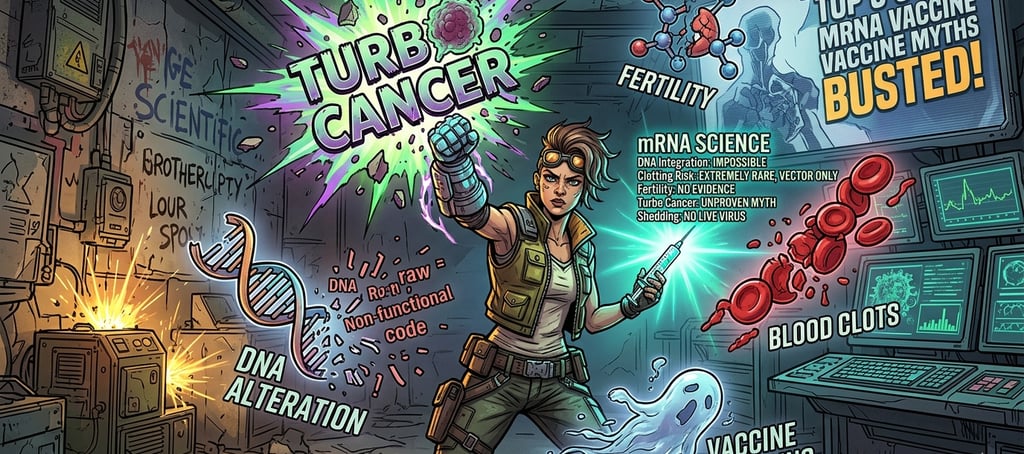
The Myths of the mRNA Vaccine
It’s been a few years since the world was turned upside down by the pandemic, and while the masks have mostly come off, the rumors about mRNA vaccines are still circulating like a stubborn virus. You’ve seen the headlines, the frantic social media threads, and the "experts" in the comments section.
It’s time to cut through the noise with some cold, hard science. Let’s tackle the top 5 myths about mRNA vaccines that just won’t die—including the ones that sound like they were ripped straight from a sci-fi thriller.
1. The "Blood Clot" Panic: Distinguishing Fact from Fiction
Let’s get one thing straight: vaccine-induced immune thrombotic thrombocytopenia (VITT) is a real, albeit extremely rare, clinical condition. However, the "blood clot myth" often conflates mRNA vaccines (Pfizer/Moderna) with adenoviral vector vaccines (AstraZeneca/J&J).
Research indicates that the specific autoimmune mechanism causing these clots was primarily associated with the vector-based platforms, not the mRNA ones. In fact, clinical data shows that subsequent doses of mRNA vaccines have been administered to VITT survivors without causing a relapse. If you’re worried about clots, remember that the risk of severe cardiovascular issues is significantly higher from a COVID-19 infection than from the jab.
2. "Turbo Cancer": A Conspiracy Without a Cause
The term "Turbo Cancer" sounds terrifying, doesn't it? It’s a catchy name for a theory claiming that mRNA vaccines cause aggressive, lightning-fast tumor growth. The problem? It isn’t a recognized medical diagnosis.
There is no evidence that mRNA vaccines can alter DNA or integrate into your genome to trigger oncogenic mutations. The "data" often cited by proponents usually stems from misinterpreted mouse studies or anecdotal reports that ignore a critical fact: the rise in late-stage cancer diagnoses post-2020 is largely attributed to pandemic-related delays in routine screenings and healthcare disruptions, not the vaccine itself.
3. The "DNA Alteration" Delusion
"It changes your DNA forever!" is the ultimate provocative hook. But biology doesn't work that way. mRNA is a messenger—it delivers a "recipe" to your cells to build a protein and then rapidly decays within the body.
For mRNA to change your DNA, it would need to enter the cell nucleus (which it can't) and be "reverse-transcribed" into DNA (which it doesn't have the tools for). While some fringe studies have explored rare interactions in lab settings, the scientific consensus remains firm: these vaccines do not interact with or modify your genetic blueprint.
4. The Fertility Fable
Fear-mongering about infertility has been a staple of anti-vax rhetoric for decades. The mRNA version claimed that the spike protein looks too much like syncytin-1, a protein essential for the placenta.
Science has thoroughly debunked this. Researchers found no significant similarities between the two proteins. Furthermore, clinical trials and massive real-world registries have shown that pregnancy and fertilization rates remain identical between vaccinated and unvaccinated groups. In fact, getting vaccinated protects pregnant individuals from severe COVID-19, which actually poses a massive risk to both parent and child.
5. "Vaccine Shedding": The Invisible Ghost
The idea that vaccinated people can "shed" the spike protein or the vaccine itself to others is a physical impossibility for mRNA technology. Unlike "live-virus" vaccines (like the oral polio vaccine), mRNA vaccines do not contain any live virus.
You cannot catch a vaccine from a hug or by standing near someone who just got their booster. The only thing being "shed" here is misinformation.
The Bottom Line
Provocative headlines sell, but they don't always tell the truth. While all medical interventions have risks, they must be weighed against the very real, very documented risks of the disease itself. Don't let a "turbo" myth keep you from making an informed decision based on actual data.
References
Gentilini, P. (2026). Exploring the potential link between mRNA COVID-19 vaccinations and cancer: A case report with a review of haematopoietic malignancies with insights into pathogenic mechanisms. Journal of Clinical Medicine. https://pmc.ncbi.nlm.nih.gov/articles/PMC12935077/
MDPI. (2026). Vaccine-Induced Immune Thrombotic Thrombocytopenia (VITT): An Immunopathogenic Model of Dysregulated Vaccine-Triggered Immunity. Vaccines. https://www.mdpi.com/2076-393X/14/3/225
Ezra. (2025). Is Turbo Cancer Real? Ezra Health Blog. https://ezra.com/blog/turbo-cancer
BC Medical Journal. (n.d.). Myths versus facts: COVID-19 vaccine effects on pregnancy, fertility, and menstruation. BCMJ. https://bcmj.org/sites/default/files/BCMJ_Vol64_No8-spec-feature.pdf
PMC. (2021). Debunking mRNA Vaccine Misconceptions—An Overview for Medical Professionals. Journal of Medical Virology. https://pmc.ncbi.nlm.nih.gov/articles/PMC7956899/